Human resource management is the system an organization uses to attract, select, organize, develop, support, reward, and retain the people needed to achieve its objectives. Effective HR management goes beyond payroll and administration: it connects workforce capabilities, job design, performance, learning, compensation, employee relations, and organizational priorities.
People are not interchangeable resources. Employees differ in experience, knowledge, motivation, judgment, learning speed, and ability to solve problems. Organizations also need different skills at different stages of growth.
That makes the central HR question broader than “How many employees do we need?”
A better question is: what workforce capabilities, behaviors, roles, management practices, and working conditions are required for the organization to perform well?
What Is Human Resource Management?
A practical human resource management definition is the coordinated management of people-related policies and practices so an organization has the workforce, capabilities, performance, and working relationships required to achieve its goals.
HR can include both administrative and strategic work.
Administrative responsibilities keep employment systems functioning. Examples include employee records, payroll coordination, contracts, leave administration, policy documentation, and compliance processes.
Strategic HR focuses on longer-term questions such as:
- which capabilities the organization will need;
- where skill shortages may appear;
- how jobs should be designed;
- which people should be recruited;
- how employees should be developed;
- which behaviors performance systems should encourage;
- how compensation should support the operating model;
- how leadership succession should be managed.
The strongest HR function integrates both levels. Administrative reliability matters, but administration alone does not determine whether the workforce can execute the organization’s business strategy.
Human Resource Management Meaning in Practical Terms
The practical meaning of HRM becomes clearer when the workforce is treated as an operating system rather than a collection of individual employment transactions.
A business may recruit talented people and still perform poorly if:
- roles are unclear;
- managers provide weak direction;
- incentives reward the wrong behavior;
- training does not address real skill gaps;
- promotion decisions are inconsistent;
- information is difficult to access;
- workload is distributed poorly;
- employees lack authority to solve routine problems.
Conversely, a well-designed people system creates reinforcing relationships between hiring, job design, management, learning, performance, rewards, and organizational culture.
This system perspective is important because improving one HR practice in isolation may produce less value than improving several complementary practices together.
The Main Functions of Human Resource Management
The exact human resources functions vary by organization, but several areas appear consistently across mature HR systems.
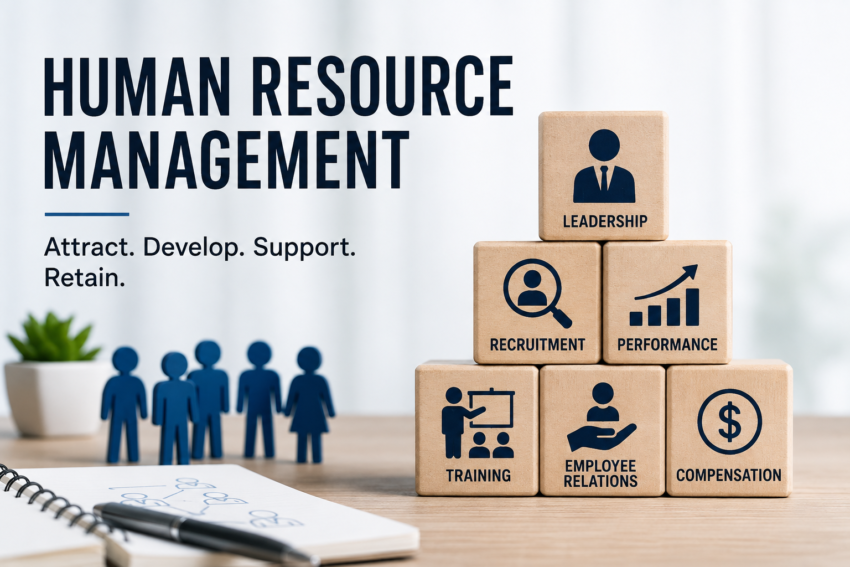
| HR Function | Main Purpose | Typical Decisions |
|---|---|---|
| Workforce planning | Match future workforce needs with business demand | Roles, headcount, skills and succession |
| Recruitment and selection | Bring suitable people into the organization | Sourcing, assessment and hiring |
| Onboarding | Help new employees become productive | Orientation, training and role integration |
| Performance management | Clarify expectations and improve performance | Goals, feedback, reviews and development |
| Learning and development | Build workforce capabilities | Training, coaching and career development |
| Compensation and rewards | Support attraction, retention and performance | Pay structures, incentives and benefits |
| Employee relations | Maintain effective workplace relationships | Policies, concerns, conflict and communication |
| People analytics | Improve workforce decisions with evidence | Hiring, turnover, skills and performance data |
These functions should not operate as separate administrative departments.
Recruitment affects training requirements. Job design influences compensation. Performance systems affect employee behavior. Workforce planning shapes hiring. Management quality influences retention.
The value comes from the connections between the practices.
Workforce Planning
Workforce planning determines which people and capabilities an organization will need to execute its future plans.
The process typically compares:
- current roles and skills;
- expected business demand;
- future capability requirements;
- retirements and turnover;
- automation and technology changes;
- internal development capacity;
- external labor availability.
Suppose a distribution company plans to automate several warehouse processes over the next three years.
A simple headcount forecast might assume fewer warehouse employees will be needed.
A stronger workforce plan asks additional questions. Which maintenance skills will automation create? Will supervisors need stronger data skills? How many employees can be retrained? Which roles disappear gradually rather than immediately? Will the new equipment require round-the-clock technical support?
This connection between people and future business requirements is why workforce planning should follow the organization’s strategic planning decisions rather than operate as an isolated HR forecast.
Recruitment and Selection
Recruitment attracts potential candidates, while selection evaluates who is most suitable for the role.
Good hiring starts before a vacancy is advertised.
The organization first needs to understand:
- the purpose of the role;
- required capabilities;
- which skills can be learned after hiring;
- what level of experience is truly necessary;
- how performance will be evaluated;
- which working conditions affect success.
Poorly defined roles create poorly defined selection criteria.
A company may ask for ten years of experience when the job actually requires analytical judgment, stakeholder communication, and familiarity with one technical system. The unnecessary requirement can shrink the candidate pool without improving hiring quality.
Selection Should Reflect the Real Job
Assessment methods become more useful when they resemble the decisions or activities employees will actually perform.
A writing role may benefit from a realistic writing task. A technical position may use a relevant problem-solving exercise. A supervisory role may include a scenario involving scheduling, conflict, or performance feedback.
The objective is to gather evidence about job-related capability rather than simply increase the number of interview stages.
Employee Onboarding
Hiring does not create productive capacity immediately.
New employees need context, tools, information, relationships, role clarity, and practical knowledge before they can perform consistently.
Effective onboarding can address:
- job expectations;
- work processes;
- systems and access;
- decision authority;
- important stakeholders;
- safety or compliance requirements;
- performance standards;
- early training;
- sources of support.
An onboarding program should not be confused with a one-day orientation.
The first day may explain policies and introduce the company. Becoming effective in a role can take weeks or months depending on complexity.
Performance Management
Performance management creates a shared understanding of what employees are expected to achieve and how performance will be discussed, supported, and improved.
A useful system connects:
organizational priorities → team outcomes → individual responsibilities → feedback → development → performance decisions.
Annual reviews alone are rarely enough.
Employees need timely information while work is still happening. Managers also need mechanisms for recognizing strong performance, diagnosing problems, and distinguishing between different causes of underperformance.
Not Every Performance Problem Is an Employee Problem
Low performance can arise from several different causes:
- insufficient skill;
- unclear expectations;
- poor process design;
- missing information;
- unavailable equipment;
- conflicting priorities;
- weak management;
- unrealistic workload;
- inappropriate incentives.
Replacing an employee does not correct a process that prevents competent people from succeeding.
HR and managers should therefore diagnose the mechanism before choosing the response.
Learning and Development
Learning and development builds the knowledge, skills, and capabilities the organization expects to need.
Training creates the most value when it addresses a defined performance or capability gap.
Sending employees to generic courses can create activity without changing workplace performance.
A stronger development process asks:
- Which capability is required?
- What is the current gap?
- Can training realistically close it?
- How will employees apply the learning?
- What support is required from managers?
- How will improvement be observed?
Not every development need requires formal classroom training.
Useful mechanisms can include coaching, mentoring, guided practice, job rotation, stretch assignments, peer learning, simulations, documentation, and structured feedback.
Compensation, Incentives and Rewards
Compensation helps organizations attract and retain employees while signaling how different roles and contributions are valued.
A reward system may include:
- base salary;
- variable pay;
- team incentives;
- benefits;
- recognition;
- promotion opportunities;
- non-financial rewards.
The design of incentives matters because employees adapt behavior to measurement systems.
Consider a sales organization that rewards revenue without considering margin or customer quality.
Employees may rationally prioritize large low-margin deals, excessive discounts, or customers that later create operational problems.
The incentive system works exactly as designed while producing an undesirable business outcome.
Effective HR management therefore evaluates both the intended behavior and the possible unintended behavior created by reward structures.
Employee Relations
Employee relations covers the working relationship between the organization and its employees.
The function may involve:
- workplace policies;
- employee concerns;
- conflict resolution;
- disciplinary processes;
- communication;
- grievances;
- workplace investigations;
- organizational change;
- manager support.
Consistency matters.
Employees may accept an unfavorable decision more readily when they understand the process and believe similar situations are handled using comparable standards.
Inconsistent treatment creates uncertainty and can undermine trust even when individual decisions appear reasonable in isolation.
Strategic HR vs Administrative HR
| Area | Administrative HR | Strategic HR |
|---|---|---|
| Primary focus | Reliable employment administration | Future workforce capability |
| Typical horizon | Current and near term | Medium and long term |
| Examples | Records, payroll support, leave, documentation | Workforce planning, capability development, succession |
| Main question | Are employment processes working correctly? | Can the workforce execute future business priorities? |
| Relationship with leadership | Service and compliance support | Workforce decision partner |
The distinction does not mean administrative work is unimportant.
Incorrect payroll, missing records, unclear policies, or unreliable employment processes quickly damage trust.
Strategic HR depends on a stable administrative foundation.
How HR Connects With Operations
People systems and operating systems are closely linked.
An operations management process may define how work should flow, but the process still depends on employee capability, staffing, supervision, incentives, job design, and learning.
Imagine a manufacturer introducing a new standardized production process.
The operational redesign may require:
- different employee skills;
- new job responsibilities;
- updated training;
- changes to supervisor roles;
- different performance measures;
- revised staffing patterns;
- new incentive structures.
If HR systems continue reinforcing the old operating model, technical process changes may not produce the intended result.
This is why workforce and operational design should be coordinated rather than implemented separately.
What Research Says About HR Practices and Productivity
Research provides an important caution against viewing HR practices as isolated policies.
A well-known study of 26 steel finishing lines examined work practices such as teams, flexible job assignments, employment security, multi-job training, communication, and incentive pay.
The researchers found substantially higher productivity where complementary practices were adopted as a coherent system. Introducing individual practices separately did not produce the same effect.
The practical implication is powerful:
HR practices can reinforce one another, which means copying one attractive policy from another company may accomplish little when the surrounding management system is incompatible.
More recent personnel-economics research also highlights persistent productivity differences among people performing similar roles and emphasizes the influence of hiring, managers, peers, incentives, training, technology, and the organization of work.
This evidence supports a systems approach to HR rather than searching for one universal “best practice.”
An HRM System From Practices to Business Outcomes
A useful way to understand the function is to follow the chain from HR decisions to organizational results.
| Level | Examples |
|---|---|
| Business direction | Growth, service, cost, quality, transformation |
| HR strategy | Capabilities and workforce priorities |
| HR practices | Recruitment, performance, learning, rewards, employee relations |
| Workforce outcomes | Skills, motivation, commitment, capability, engagement |
| Business outcomes | Productivity, quality, customer performance, execution |
An OECD human resource management framework uses a similar logic. It connects recruitment, performance management, learning and development, remuneration, and employee relations with outcomes such as motivation, commitment, skills, competencies, capabilities, engagement, productivity, quality, and customer satisfaction.
The framework demonstrates why HR metrics should not stop at activity counts.
Knowing that 500 employees attended training says little unless the organization can establish whether capability or performance improved.
What Are the Objectives of Human Resource Management?
The objectives of human resource management vary with the organization, but several goals are broadly relevant.
Build Required Capability
The organization needs the knowledge and skills required for current and future work.
Place People in Suitable Roles
Strong employees can underperform when their capabilities and responsibilities are poorly matched.
Create Clear Expectations
Employees need to understand expected outcomes, priorities, authority, and standards.
Support Performance
HR systems should help managers identify barriers, provide feedback, and develop employees where improvement is possible.
Retain Critical Knowledge
Some capabilities take years to develop and cannot be replaced immediately through external hiring.
Maintain Effective Employment Systems
Reliable policies, pay, records, communications, and workplace procedures form the administrative foundation for the employment relationship.
Adapt the Workforce as the Organization Changes
Technology, markets, regulations, and business models alter which capabilities remain valuable.
HR must support adaptation without assuming that today’s role structure should continue indefinitely.
How to Measure Human Resource Management
HR metrics become more useful when they connect activity with workforce or business outcomes.
| Area | Possible Metric | Important Limitation |
|---|---|---|
| Recruitment | Time to fill | Fast hiring does not prove hiring quality |
| Selection | New-hire performance | Performance is also influenced by managers and onboarding |
| Retention | Turnover rate | Not all turnover has equal business impact |
| Learning | Capability improvement | Course completion alone measures activity |
| Performance | Goal achievement | Goals can encourage unintended behavior |
| Workforce | Critical skill coverage | Headcount alone does not describe capability |
| Internal mobility | Internal fill rate | A high rate is not useful if capability is weak |
HR dashboards should therefore avoid treating every number as an optimization target.
Driving time to hire as low as possible could reduce assessment quality. Minimizing turnover could retain people who are poorly matched to the organization. Maximizing training hours could consume time without improving skills.
Metrics should support decisions, not replace judgment.
A Practical Human Resource Management Example
Consider a fictional industrial services company expanding into three new regions.
The Business Requirement
Management expects customer demand to grow quickly but knows that experienced technical supervisors are already difficult to recruit.
Workforce Planning
HR and operations estimate how many technicians, supervisors, planners, and support employees each location will require.
The analysis shows that supervisor availability is the largest workforce constraint.
Recruitment
The company begins recruiting technicians externally but avoids relying exclusively on outside hiring for supervisors.
Development
Experienced technicians with leadership potential enter a structured development program covering planning, coaching, safety, customer communication, and performance management.
Job Design
Administrative scheduling work is moved away from supervisors so they can spend more time supporting field teams.
Performance
Supervisor performance measures include service quality, team capability, safety, scheduling reliability, and customer outcomes rather than simply total jobs completed.
Succession
Each regional manager maintains visibility into employees who could assume larger responsibilities during future expansion.
The example demonstrates an integrated HR system.
The company does not attempt to solve the expansion challenge with recruitment alone. Workforce planning, internal development, job design, performance systems, and succession reinforce the same business requirement.
Common Human Resource Management Failures
Copying HR Best Practices Without Context
Warning sign: A company introduces a policy mainly because successful employers use it.
Why it fails: The practice may depend on different jobs, managers, workforce skills, economics, or organizational culture.
Better approach: Begin with the workforce outcome the organization needs and evaluate which practices support that outcome.
Measuring HR Activity Instead of Impact
Warning sign: HR reports recruitment campaigns, training hours, interviews, and completed reviews without linking them to workforce outcomes.
Why it fails: Large amounts of activity can coexist with persistent skill gaps or performance problems.
Better approach: Connect key HR measures with capability, retention, performance, quality, or other relevant outcomes.
Making HR Responsible for Every People Problem
Warning sign: Managers send performance, communication, or team problems to HR without taking ownership.
Why it fails: Direct managers influence daily expectations, feedback, workload, priorities, and development.
Better approach: HR should build systems and support managers while operational leaders remain accountable for managing their teams.
Recruiting Before Fixing Job Design
Warning sign: The same role experiences repeated vacancies and poor retention.
Why it fails: Hiring is used to refill a role whose workload, expectations, authority, schedule, or management conditions remain problematic.
Better approach: Investigate the role and working system before assuming recruitment is the only problem.
Using Training to Fix Non-Training Problems
Warning sign: Employees are repeatedly sent to courses despite unclear procedures, poor tools, or conflicting objectives.
Why it fails: Knowledge cannot compensate for a broken operating environment.
Better approach: Determine whether the performance gap comes from skill, process, information, resources, incentives, or management.
Rewarding the Wrong Behavior
Warning sign: Employees achieve their individual targets while total business performance deteriorates.
Why it fails: Local incentives encourage actions that shift cost or problems elsewhere.
Better approach: Test performance measures for likely unintended consequences before attaching meaningful rewards.
Ignoring Critical Knowledge Concentration
Warning sign: One or two employees are the only people capable of performing essential work.
Why it fails: Turnover, illness, retirement, or promotion can suddenly remove organizational capability.
Better approach: Identify critical knowledge, develop backups, improve documentation, and create succession options.
A Practical HR System Test
| Question | Strong Evidence |
|---|---|
| Do we know which capabilities the strategy requires? | Workforce requirements linked to business priorities |
| Are roles designed clearly? | Defined outcomes, authority and responsibilities |
| Does selection reflect the real work? | Job-related assessment criteria |
| Can new employees become productive efficiently? | Structured onboarding and role support |
| Do employees understand expected performance? | Clear goals and timely feedback |
| Does development address real gaps? | Capability change rather than attendance alone |
| Do rewards reinforce desired behavior? | Measures aligned with total outcomes |
| Can critical roles be replaced? | Succession and skill coverage |
A weakness in one area does not automatically require a major HR transformation.
The purpose of the test is to identify where the people system breaks the connection between business requirements and workforce performance.
Frequently Asked Questions
What is human resource management?
Human resource management is the coordinated system used to attract, select, organize, develop, support, reward, and retain employees. HRM connects employment practices with the workforce capabilities and behaviors an organization needs to achieve its objectives.
What are the main functions of human resource management?
Major functions include workforce planning, recruitment and selection, onboarding, performance management, learning and development, compensation, employee relations, succession planning, workforce administration, and people analytics. The exact combination varies according to the organization.
Why is human resource management important?
Human resource management is important because business performance depends partly on having suitable people in appropriate roles with the skills, information, management support, incentives, and working conditions needed to perform effectively.
What is HR management?
HR management is another common term for human resource management. It covers the policies, systems, decisions, and management practices used to organize the employment relationship and align workforce capabilities with organizational needs.
What are the objectives of human resource management?
Common HR objectives include building required skills, recruiting suitable employees, supporting performance, developing future capability, retaining critical knowledge, maintaining reliable employment systems, and helping the workforce adapt as organizational needs change.
What is the difference between HR and human resource management?
HR often refers to the organizational function or department responsible for people-related processes. Human resource management describes the wider system of practices and decisions used by HR specialists, managers, and leaders to manage the workforce.
Is HR responsible for employee performance?
HR supports performance by designing systems, policies, tools, development processes, and manager guidance. Direct managers remain responsible for setting expectations, providing feedback, organizing work, making decisions, and managing day-to-day employee performance.
How does human resource management affect productivity?
HR practices can affect productivity through hiring quality, job design, training, incentives, management, teamwork, employee capability, and work organization. Research suggests complementary systems of HR practices can be more effective than isolated policies implemented independently.
Final Takeaway
Human resource management is not simply the administrative management of employees.
A strong HR system connects business requirements with workforce planning, recruitment, job design, onboarding, performance, learning, rewards, employee relations, and succession.
The individual practices matter, but the relationships between them matter just as much.
A company can hire talented people and still create weak performance through unclear roles, poor management, misaligned incentives, or inadequate development. Another organization can strengthen its workforce by designing complementary practices around the capabilities it genuinely needs.
The most useful HR question is therefore not “Which HR practices should we have?”
Ask instead: “What capabilities and behaviors does the organization need, and do our people systems consistently help employees develop and apply them?”
When the answer is supported by evidence, human resource management becomes a business capability rather than a collection of employment processes.