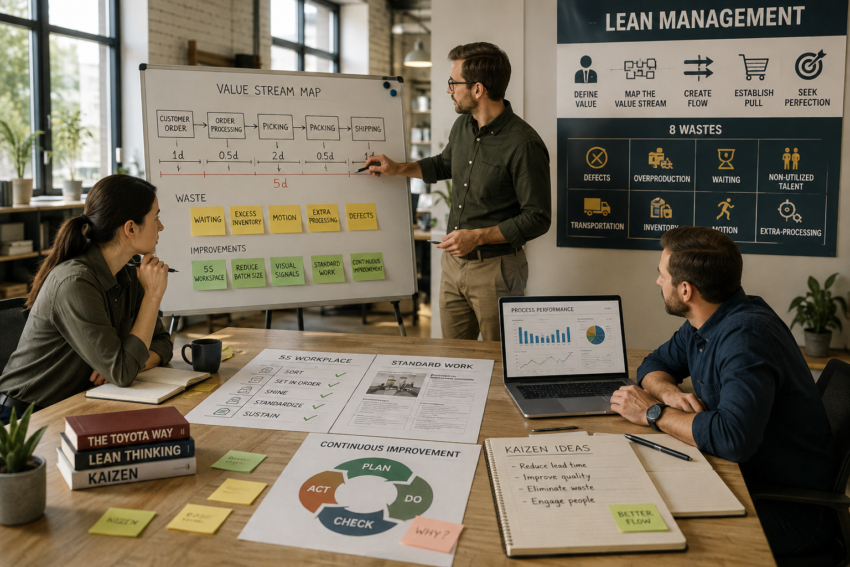
Lean management is a management approach that improves how value flows through an organization by reducing unnecessary work, solving problems systematically, and continually improving processes. Lean is not simply a cost-cutting program or collection of efficiency tools. A mature lean system connects customer value, workflow, employee problem solving, quality, leadership, and continuous improvement.
The central idea is straightforward: resources should be spent on activities that create meaningful value, while delays, defects, unnecessary movement, excess inventory, rework, waiting, and other forms of waste should be reduced.
That principle applies far beyond manufacturing. Service companies, healthcare organizations, warehouses, offices, software teams, and public-sector operations can all examine how work flows and where effort fails to create useful outcomes.
What Is Lean Management?
A practical lean management meaning is an operating and management system designed to improve customer value while systematically removing waste and developing the organization’s ability to solve problems.
Lean fits naturally within operations management because both disciplines examine how resources, processes, information, capacity, and people combine to produce an output.
The difference is emphasis. General operations management covers the full design and control of operating systems. Lean provides a particular way of thinking about those systems: understand value, observe the actual process, improve flow, expose problems, reduce waste, and keep learning.
A warehouse, for example, might appear efficient because every employee stays busy. Closer observation could reveal that employees spend large amounts of time walking between poorly located storage areas, searching for items, correcting inventory errors, and waiting for replenishment.
Lean asks whether that activity creates customer value rather than whether employees simply appear occupied.
Lean Is More Than Waste Reduction
Waste elimination is strongly associated with lean, but treating lean only as a waste-removal exercise produces an incomplete model.
The Lean Enterprise Institute describes lean as a business system that links improvement of work with development of people. The U.S. Environmental Protection Agency similarly describes lean as a combination of management system, organizational culture, and continual-improvement methods rather than a standalone efficiency technique.
This broader view matters because processes do not remain improved automatically.
Employees encounter changing demand, new products, equipment failures, supplier problems, customer exceptions, quality issues, and new constraints. A lean organization therefore needs people who can recognize abnormal conditions, investigate causes, test countermeasures, and improve standards.
The goal is not to design one perfect process and preserve it forever.
The stronger objective is to build an organization capable of repeatedly making work better.
Where Lean Management Came From
Modern lean thinking is closely associated with the Toyota Production System.
Toyota developed its production approach under conditions very different from the large-scale mass-production environment that dominated much of the automobile industry. Limited resources and smaller production volumes made it important to reduce waste, improve flow, and produce what was required without creating unnecessary excess.
Toyota describes the Toyota Production System around two foundational concepts:
- Just-in-Time — producing and moving what is needed, when it is needed, in the required quantity;
- Jidoka — building quality into the process by making abnormalities visible and preventing defective work from continuing unnoticed.
Continuous improvement, or kaizen, developed alongside those operating principles.
An important lesson from Toyota’s own historical material is that the system did not emerge as a collection of disconnected tools. Production flow, quality, employee capability, problem solving, equipment, and material movement evolved together over many years.
That history helps explain why copying individual lean tools does not necessarily reproduce a lean management system.
The Core Principles of Lean Management
Different organizations describe lean management principles in slightly different ways, but the underlying logic can be summarized through five connected ideas.
Define Customer Value
Improvement starts by understanding what the customer actually needs.
Value may include:
- quality;
- reliability;
- speed;
- availability;
- accuracy;
- functionality;
- convenience;
- appropriate customization.
A task is not valuable merely because the organization has performed it for years.
Managers should ask whether the activity changes the product, service, or outcome in a way the customer needs, whether it is required for another legitimate reason, or whether it exists because the current process is poorly designed.
Understand the Value Stream
A value stream is the sequence of activities required to deliver a particular product, service, or outcome.
Looking across the entire stream prevents departments from optimizing their own activities while damaging total performance.
A purchasing team might reduce unit prices by ordering larger quantities. Warehouse inventory then increases, more space is consumed, products remain unused longer, and the company becomes less responsive to changing demand.
Purchasing performance may improve according to one metric while the complete value stream becomes worse.
Create Better Flow
Flow describes how smoothly work moves from one activity to the next.
Poor flow appears as:
- queues;
- work waiting for approval;
- unfinished inventory;
- large batches;
- repeated handoffs;
- unbalanced workloads;
- frequent interruptions;
- information arriving too late.
Improving flow does not mean every process must literally move one item at a time. The appropriate design depends on the economics and constraints of the work.
The underlying objective is to reduce unnecessary waiting and make problems visible sooner.
Respond to Real Demand
Lean operations try to avoid producing work simply because capacity is available.
A pull-oriented system responds to downstream demand instead of pushing excessive work into the next stage.
The idea can apply outside manufacturing.
An administrative team that starts hundreds of requests simultaneously may create large queues of partially completed work. Limiting work in progress can allow employees to finish existing tasks before beginning more, making priorities and bottlenecks easier to see.
Pursue Continuous Improvement
Lean assumes that today’s process can be improved.
Continuous improvement does not require constant large-scale transformation. Many useful changes are small: moving a frequently used tool, changing the sequence of a task, clarifying a visual signal, eliminating an unnecessary approval, or simplifying how information is entered.
The cumulative effect matters when improvements become part of normal work rather than occasional management campaigns.
What Is Waste in Lean?
Lean classifies waste as effort or resource consumption that does not create needed value.
A common framework identifies several recurring forms.
| Waste | What It Looks Like | Example |
|---|---|---|
| Waiting | Work stops because something is unavailable | An order waits two days for routine approval |
| Overproduction | Work is produced before it is needed | Manufacturing excess units without demand |
| Inventory | Excess unfinished or finished work accumulates | Large queues of open service requests |
| Defects | Work must be corrected or repeated | Incorrect order information requires reprocessing |
| Motion | People move unnecessarily | Employees repeatedly walk to distant tools |
| Transportation | Materials or information move without creating value | Products travel between poorly arranged work areas |
| Overprocessing | More work is performed than the outcome requires | Several managers approve a routine low-risk request |
| Unused capability | Employee knowledge is not used effectively | Frontline staff see recurring problems but cannot suggest changes |
Not every non-customer-facing activity can be eliminated.
Regulatory checks, safety procedures, accounting controls, cybersecurity measures, and necessary maintenance may not directly transform a customer output, yet the organization may still require them.
A better question is therefore not “Does the customer pay for this exact activity?” but “Is this work necessary to create, protect, or reliably deliver the required outcome?”
Lean Management Tools and What They Actually Do
Lean management tools are useful when they solve a defined problem. Applying them because an organization wants to “be lean” reverses the correct logic.
Value Stream Mapping
Value stream mapping visualizes how work and information move through an end-to-end process.
The map can expose:
- waiting;
- queues;
- rework;
- large batches;
- unnecessary handoffs;
- information delays;
- bottlenecks.
The value comes from seeing relationships across the process rather than producing an attractive diagram.
5S
5S creates an organized workplace where required items are easier to locate, abnormalities become more visible, and standards are easier to maintain.
Although 5S is frequently associated with physical factories, the underlying idea can apply to digital files, tools, shared workspaces, laboratories, maintenance areas, and administrative environments.
A clean workspace alone is not evidence of lean transformation. The arrangement should improve the work.
Kanban
Kanban uses visual signals to coordinate work or replenishment.
A well-designed kanban system can make status, demand, work limits, and replenishment needs easier to understand.
The visual board itself is only a mechanism. The important part is the decision rule attached to the signal.
Standard Work
Standard work documents the current agreed method for completing a recurring process.
Standards support training, consistency, measurement, and improvement because teams have a known baseline.
Standardization should not mean employees are forbidden to think. When a better method is proven, the standard should change.
Kaizen
Kaizen continuous improvement encourages employees to identify problems and improve work systematically.
Toyota describes kaizen as an ongoing effort to improve business operations and investigate underlying causes rather than accepting problems as normal.
Small improvements can be especially valuable when employees closest to the process can test changes quickly.
Root Cause Analysis
Root cause analysis moves beyond correcting the immediate symptom.
If an order is shipped incorrectly, replacing the product solves the customer problem today. A deeper investigation asks why the wrong item was selected, why the error was not detected, and which condition allowed the failure to occur.
A Practical Lean Management System
A sustainable lean management system combines tools with management routines.
A useful structure contains six layers.
| Layer | Purpose |
|---|---|
| Customer value | Define the outcome that matters |
| Process visibility | Make flow and problems observable |
| Standard work | Create a stable baseline |
| Problem solving | Investigate causes and test countermeasures |
| People development | Build employee capability to improve work |
| Management review | Reinforce priorities and learning |
The layers reinforce one another.
Without process visibility, problems remain hidden. Without a stable baseline, teams cannot distinguish normal variation from abnormal conditions. Weak problem solving creates temporary fixes. Limited employee involvement makes improvement dependent on managers or consultants.
Tools alone therefore rarely sustain lean performance.
What Real Lean Improvements Can Look Like
Recent Manufacturing Extension Partnership case studies provide useful examples because they report operational changes rather than abstract claims.
Reducing Work in Progress and Lead Time
One manufacturer used waste identification and one-piece-flow cells on selected product lines. The reported results included a 50% reduction in lead time, a decline in work-in-process inventory from 105 units to 5, and an increase in daily production from 40 units to 105.
The important insight is not that every company should copy one-piece flow.
The case demonstrates how reducing work sitting between steps can simultaneously expose capacity, shorten feedback cycles, and reduce inventory.
From Two Days to Minutes
Another small manufacturer combined 5S training with a move away from batch processing. According to the NIST MEP case study, a unit that previously required up to two days before shipment could eventually be ready in about 20 minutes.
That result came from redesigning the physical workflow rather than asking employees to work faster inside the old process.
Reducing Returns and Improving Capacity
A 2025 NIST MEP case involving Lean and Six Sigma reported a decline in return rates from 7% to 2%, approximately 30% greater capacity, and lead-time reduction from 12 weeks to 8 weeks.
Those examples should not be interpreted as guaranteed lean outcomes. The size of an improvement depends on the starting process, constraints, implementation quality, demand, and measurement method.
The more transferable lesson is that lean creates value when teams diagnose a specific flow, quality, or capacity problem and change the system producing that problem.
Lean Management and Competitive Advantage
Lean can support competitive advantage, but lower waste does not automatically create a defensible position.
Competitors can learn common lean techniques. Many organizations can purchase similar equipment, attend the same training, or use the same process-improvement terminology.
A stronger advantage emerges when years of improvement create a system of capabilities that is difficult to reproduce:
- employees recognize abnormal conditions quickly;
- problems are surfaced rather than hidden;
- leaders coach structured problem solving;
- process data is reliable;
- supplier relationships support flow;
- standards evolve through learning;
- improvement becomes routine.
The individual tool may be easy to copy. The accumulated management system can be much harder to imitate.
Lean Does Not Mean Running With No Capacity Buffer
One dangerous interpretation of lean is that every form of spare capacity, inventory, or redundancy must disappear.
That conclusion ignores uncertainty.
A system facing highly variable demand, unreliable suppliers, equipment risk, long replenishment times, or costly service failures may rationally maintain buffers.
The relevant question is whether the buffer protects the system against a real risk at an acceptable cost.
Removing inventory without improving supplier reliability can increase stockouts. Maximizing employee utilization can increase queues when demand varies. Eliminating spare capacity from a critical process can make recovery from disruption much harder.
Lean should remove unnecessary buffers, not blindly eliminate every form of resilience.
How to Start Lean Process Improvement
An organization does not need to transform every department simultaneously.
A focused continuous improvement process is often more practical.
1. Select a Real Problem
Choose a problem with an observable consequence, such as excessive lead time, frequent defects, high work in progress, repeated customer complaints, or unnecessary movement.
2. Observe the Actual Work
Do not rely solely on written procedures.
Follow the process as employees and customers actually experience it.
3. Establish a Baseline
Record a small number of measures before changing the process.
Possible measures include:
- lead time;
- processing time;
- queue time;
- defect rate;
- work in progress;
- distance traveled;
- throughput;
- rework;
- on-time completion.
4. Identify the Main Sources of Waste
Look for where work stops, moves unnecessarily, accumulates, repeats, or requires correction.
A team should resist the temptation to fix every observation at once.
5. Find the Underlying Cause
Repeated symptoms deserve investigation.
If employees continually search for components, the answer may involve location standards, replenishment, inaccurate inventory records, workspace design, or supplier packaging.
6. Test a Countermeasure
Use a manageable experiment where possible.
A limited test reduces implementation risk and creates faster feedback.
7. Measure the Result
Compare performance with the baseline.
A change that looks cleaner or feels faster should still produce an observable improvement in the outcome that motivated the project.
8. Standardize What Works
Update procedures, visual controls, training, responsibilities, or systems so the improved method becomes normal work.
9. Continue Learning
Standardization creates a new baseline, not a permanent endpoint.
Future observations can reveal another improvement opportunity.
Continuous Improvement vs Large Transformation Projects
Continuous improvement and major transformation are not alternatives in every situation.
Incremental improvement works especially well when the basic operating model is appropriate but contains many solvable problems.
A larger redesign may be necessary when:
- technology fundamentally changes the process;
- capacity must expand dramatically;
- a facility is being relocated;
- the product architecture changes;
- the business enters a different market;
- the existing workflow cannot support the required strategy.
Strategic choices should therefore determine the scale of change. A company’s strategic planning process can identify where incremental improvement is sufficient and where the operating model itself needs redesign.
Continuous improvement should make a good system better. It should not prevent management from replacing a system that no longer fits the strategy.
Common Lean Management Failures
Treating Lean as a Cost-Cutting Program
Warning sign: Lean is introduced mainly as a way to reduce headcount.
Why it fails: Employees quickly learn that identifying waste may threaten their own jobs, giving them an incentive to hide improvement opportunities.
Better approach: Connect productivity gains to growth, capacity, service, quality, safer work, and development of employee capability.
Starting With Tools Instead of Problems
Warning sign: Management mandates 5S, kanban, or value stream mapping everywhere before defining the operational problems.
Why it fails: Teams perform visible lean activities without improving meaningful outcomes.
Better approach: Begin with a measurable problem and select the method appropriate to that problem.
Improving One Department in Isolation
Warning sign: One area produces work faster, but queues grow immediately downstream.
Why it fails: Local efficiency does not necessarily improve total flow.
Better approach: Measure the end-to-end value stream and understand the system constraint.
Removing Buffers Before Reducing Variation
Warning sign: Inventory or capacity is cut while supplier, equipment, or demand variability remains unchanged.
Why it fails: The buffer was masking instability that has not yet been solved.
Better approach: Understand why the buffer exists, improve the underlying source of variation, and then test whether less protection is safe.
Creating Standards That Never Change
Warning sign: Employees follow outdated procedures because deviations are discouraged.
Why it fails: Standard work becomes bureaucracy instead of a baseline for learning.
Better approach: Preserve consistency while creating a controlled process for proposing and validating improvements.
Running Isolated Kaizen Events
Warning sign: Improvement activity spikes during workshops and disappears afterward.
Why it fails: Management routines do not reinforce the new process.
Better approach: Assign ownership, measures, follow-up dates, and operating standards after each improvement.
Ignoring Employee Knowledge
Warning sign: Process redesign is performed entirely by managers or outside specialists.
Why it fails: People doing the work often understand exceptions, constraints, and failure modes that process documentation misses.
Better approach: Combine frontline observation with management perspective and relevant data.
A Lean Decision Test
| Question | Useful Evidence |
|---|---|
| What customer outcome matters? | A specific requirement such as quality, speed or reliability |
| Where does work wait? | Queue and lead-time data |
| Where does work repeat? | Defects, rework and reopened tasks |
| What limits total flow? | Observed bottleneck or constrained resource |
| Which activity creates no necessary value? | Process observation and value-stream analysis |
| What should change first? | A specific root cause with measurable impact |
| Did the countermeasure work? | Post-change performance compared with baseline |
| Can the gain be sustained? | Standard, owner, training and review mechanism |
The test deliberately ends with sustainability.
An improvement that disappears after several weeks is not yet a stable process improvement.
Frequently Asked Questions
What is lean management?
Lean management is a management approach that improves customer value by reducing unnecessary activity, improving workflow, solving problems systematically, and involving employees in continuous improvement. Lean combines operating principles, management routines, organizational culture, and practical improvement tools.
What are the main lean management principles?
Core lean principles include defining customer value, understanding the value stream, improving flow, responding to real demand, exposing and solving problems, developing people, and continuously improving the operating system.
What is lean operations?
Lean operations apply lean principles to the design and management of everyday work. The objective is to improve the flow of products, services, materials, or information while reducing delays, defects, excess work in progress, unnecessary movement, and other non-value-added activity.
What are common lean management tools?
Common lean management tools include value stream mapping, 5S, kanban, standard work, visual management, kaizen, root cause analysis, one-piece flow, mistake-proofing, and structured problem-solving methods. A tool should be selected for a specific operational problem rather than deployed for its own sake.
What is kaizen continuous improvement?
Kaizen is an approach to ongoing improvement in which employees identify problems, investigate causes, test countermeasures, and improve work over time. Kaizen often emphasizes frequent practical improvements rather than relying exclusively on large transformation projects.
Does lean management only apply to manufacturing?
No. Lean principles can be applied to services, healthcare, logistics, administrative work, software development, laboratories, public organizations, and other environments where work flows through repeatable processes and customers depend on quality, speed, reliability, or accuracy.
Does lean mean eliminating all inventory?
No. Lean seeks to eliminate unnecessary inventory while preserving the buffers needed to manage real uncertainty and risk. Removing inventory without improving demand visibility, supplier reliability, process stability, or replenishment can reduce service performance rather than improve it.
What is a lean management system?
A lean management system combines process standards, visual management, performance review, problem solving, employee development, leadership routines, and continuous improvement. The system helps an organization sustain gains instead of depending on isolated improvement projects.
Final Takeaway
Lean management is not a race to make employees work faster, remove every buffer, or cover the workplace with improvement terminology.
The stronger idea is to understand what customers value, observe how work actually flows, expose unnecessary effort and instability, solve underlying problems, and build employee capability to keep improving the system.
Tools such as 5S, kanban, value stream mapping, and kaizen can support that work, but tools are not the objective.
A useful lean question is: “What prevents value from flowing reliably through this process, and what evidence shows that our next change will improve it?”
Organizations that keep asking that question can turn lean from a temporary improvement program into a repeatable management capability.